












Shakedown: Hawaii review

Shakedown: Hawaii Review — A Smart, Satirical Blend of Crime and Business
Shakedown: Hawaii is the kind of game that looks simple at first glance, then quietly reveals a deeper layer of planning, pace, and satire the longer you play. As someone who has spent years bouncing between open-world crime games, arcade throwbacks, and management sandboxes, I found this one to be a smart little hybrid that knows exactly what it wants to be. It is not trying to compete with giant open-world blockbusters. Instead, it leans into compact design, sharp humor, and a constant loop of building, expanding, and disrupting a city that feels both playful and strangely strategic.
The easiest way to describe it is this: if you enjoyed old-school top-down action games but always wished there was more structure behind the chaos, Shakedown: Hawaii gives you that extra layer. You can still roam, cause trouble, and explore, but the real hook comes from turning shady business into a business empire. That twist keeps the whole experience moving. The result is a game that feels like an action-comedy mixed with a light economic sim, and that combination works better than it has any right to.
A retro world with modern bite
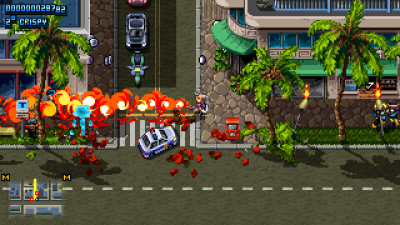
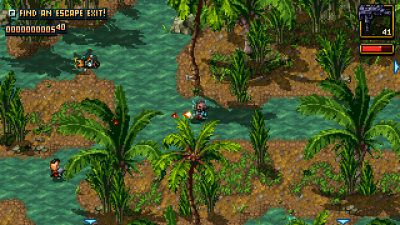
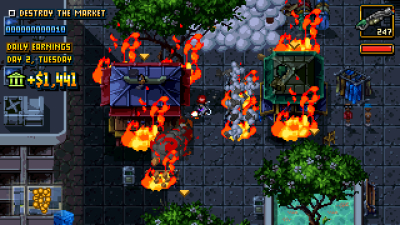
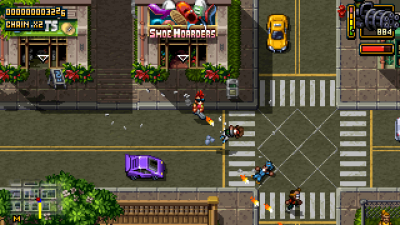
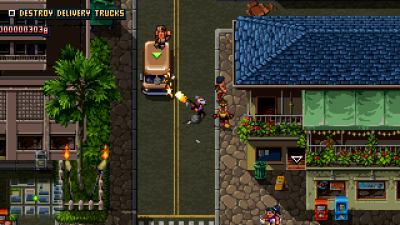
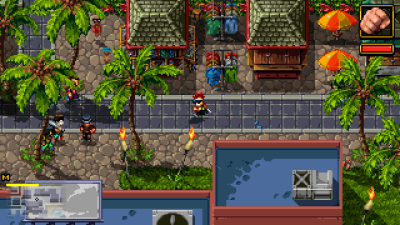
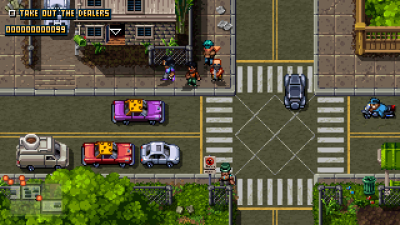
The presentation is one of the first things that stands out. Shakedown: Hawaii uses a clean pixel-art style that is colorful without being noisy, and it gives the whole world a polished retro identity. This is not a nostalgic skin slapped over a modern game; it feels built from the ground up to support fast movement, readable environments, and comedic timing. Cars, shops, characters, and street traffic all have a kind of toy-like clarity that makes the urban setting easy to read at a glance.
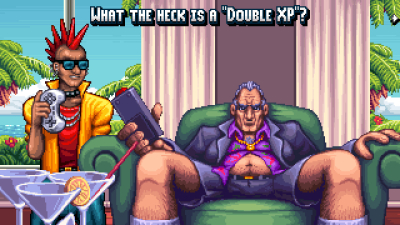
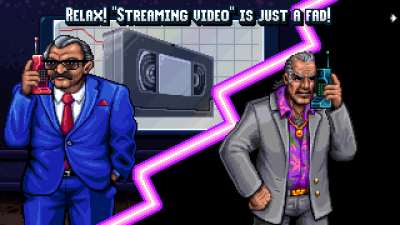
The satire also lands well. The game pokes fun at corporate greed, property expansion, and the absurd logic behind modern business culture. It has that old GTA-style energy where everyone is talking past each other, chasing money, or trying to justify nonsense with a straight face. The writing is light, but it keeps the tone sharp enough to hold the whole thing together. I would call it witty rather than laugh-out-loud funny, which suits the game better anyway.
Why the gameplay loop works so well
At its core, Shakedown: Hawaii is about movement and momentum. You take on missions, travel across the map, and switch between direct action and business planning. One moment you are handling a small objective, and the next you are deciding how to expand a storefront, undercut competition, or push your reach into a new district. That alternating rhythm gives the game its identity. It never settles into being just a crime sandbox or just a tycoon sim. It keeps folding one part into the other.
The action feels intentionally lightweight, but that is not a flaw. The combat and driving are tuned for arcade flow rather than realism. You are meant to glide through the city, not wrestle with systems that punish every turn. That makes the game very easy to pick up, and it is also what keeps it approachable for players who want to play in short sessions. It is the sort of game you can boot up, make clear progress, and still feel like you accomplished something even if you only played for half an hour.
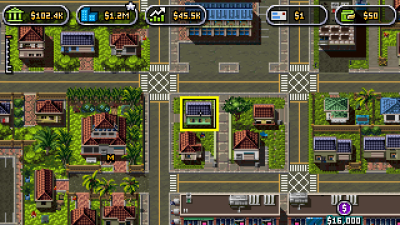
Business expansion is where the game really comes alive. New properties, upgraded services, and increasingly aggressive market dominance create a satisfying sense of escalation. It gives you a reason to care about the map beyond simple exploration. Streets stop being scenery and start feeling like territory. That shift is subtle, but it is the reason the game has more staying power than many similarly styled indie releases.
How it feels to move through the city
The city itself is compact, but that works in its favor. Big open worlds can become exhausting when too much of the map is filler. Shakedown: Hawaii keeps things tighter, which means you spend less time wandering and more time making decisions. Shops, mission points, and traffic lanes all sit close enough together that the pacing stays brisk. You are never far from the next objective or the next chance to improve your operation.
Travel is straightforward, and that simplicity fits the rest of the design. The game does not want you to get bogged down in friction. It wants you to jump from one activity to another and keep the larger cycle turning. If you are the kind of player who values efficiency and likes seeing systems connect cleanly, that design philosophy is easy to appreciate. If you prefer sprawling simulation depth, you may wish there was more complexity in the city itself. But for what it is aiming to do, the structure is smart and focused.
Challenge, progression, and replay value
Shakedown: Hawaii is not brutally difficult, but it does ask you to think about how you spend time and money. Progress comes from making the right calls on expansion and mission flow, and there is enough flexibility that different players may prioritize things differently. Some will push hard on the action side and race through objectives. Others will slow down and treat the business layer as the real game. Both approaches work, which is a strength.
Replay value comes from the way the world responds to your growing influence. Once you understand the systems, you can optimize your runs and experiment with different paths through the map. That said, the game is not endless in the way live-service or giant sandbox titles are. It has a finite charm, and that is probably a good thing. It respects your time. When a game knows when to stop, it often leaves a better impression than one that overstays its welcome.
Platforms, performance, and general accessibility
For players looking to download and play, Shakedown: Hawaii has a practical low-friction appeal. It has appeared on multiple platforms, which makes it easy to install depending on your preferred system. On PC, it is the most straightforward setup, and on consoles it fits naturally into the pick-up-and-play style. If you are checking platforms for portability, it is the type of game that makes sense on handheld-friendly systems as well, since the mission structure suits shorter sessions.
Performance is generally smooth, and the visual style helps the game run cleanly without needing high-end hardware. That matters for anyone hoping to play on older devices or on a modest PC. If you are wondering about free access, the official version is not typically free, though availability can vary during promotions or subscription periods. I would not expect a completely free version unless it is part of a special offer from a storefront or service.
What stands out, and what holds it back
What I like most is the confidence. Shakedown: Hawaii knows it is a compact, satirical, systems-driven action game, and it commits to that identity without chasing trendier design ideas. It does not inflate itself with unnecessary mechanics, and it does not pretend to be a giant sandbox when it does not need to be. That restraint gives it personality.
The main limitation is that some players may want more depth in the moment-to-moment action. The combat is serviceable, but it is not the star of the show. The driving is functional rather than exhilarating. If you come in expecting a deeply technical action game, you may feel the edges. But if you appreciate games that build momentum through interlocking systems, the experience is much more satisfying than its modest appearance suggests.
As for cheats and mods, the scene depends on platform and community support. On PC, you may find mods or unofficial tweaks from the community, while console support is usually far more limited. Cheats are not a core part of the intended experience, and I would treat any third-party tools carefully. The game is best enjoyed normally the first time through, since its balance and progression are part of the charm.
Final verdict
Shakedown: Hawaii is a clever, compact, and surprisingly addictive game that does a lot with a modest framework. It mixes action, strategy, and business growth in a way that feels fresh even when its individual parts are familiar. The satire is on point, the pacing is solid, and the retro presentation gives it a distinct identity that never feels gimmicky. I would recommend it to anyone who likes open-world chaos but wants something more focused, or to players who enjoy games that reward smart expansion as much as quick reflexes.
If you want a game to download that is easy to install, easy to understand, and hard to put down once its loop clicks, Shakedown: Hawaii is an excellent pick. It is not the biggest name in the genre, but it has enough style and design discipline to earn a place on a priority review page without question.
How to download Shakedown: Hawaii
Availability & Launch: Shakedown: Hawaii is available through major digital storefronts rather than as a free default release. You can purchase and download it on supported platforms, and occasional discounts may appear depending on the store.
Platforms: The game is available on PC and several console platforms, with handheld-friendly support on select systems. If a platform is not supported, you would need an emulator or cloud solution only if a storefront or service provides it indirectly; otherwise, use the official version for your device. Always check the current store listing before you install.
Install: Buy the game from the relevant storefront, sign in, download the client files, and follow the on-screen install prompts. On consoles, it is usually a standard library download. On PC, make sure your launcher is updated before you install.
System Requirements: For PC, modest hardware is enough; a basic dual-core CPU, 4 GB RAM, and integrated graphics should handle it comfortably. Mac support, if listed on your store page, is usually similar at a low-to-mid level. Android is not a standard native target, so there is no routine mobile install path unless an official release exists.
Cheats / Mods: Cheats are not part of the base experience, and mods are mostly a community topic on PC. If you use mods, do so carefully and only from trusted sources. Console versions are typically limited or unsupported in this area.
Unblocked Access: It is not designed specifically for unblocked play in school or work environments. If a network or device restricts game access, you may need permission or an approved platform. Browsers and external bypass methods are not the intended route.